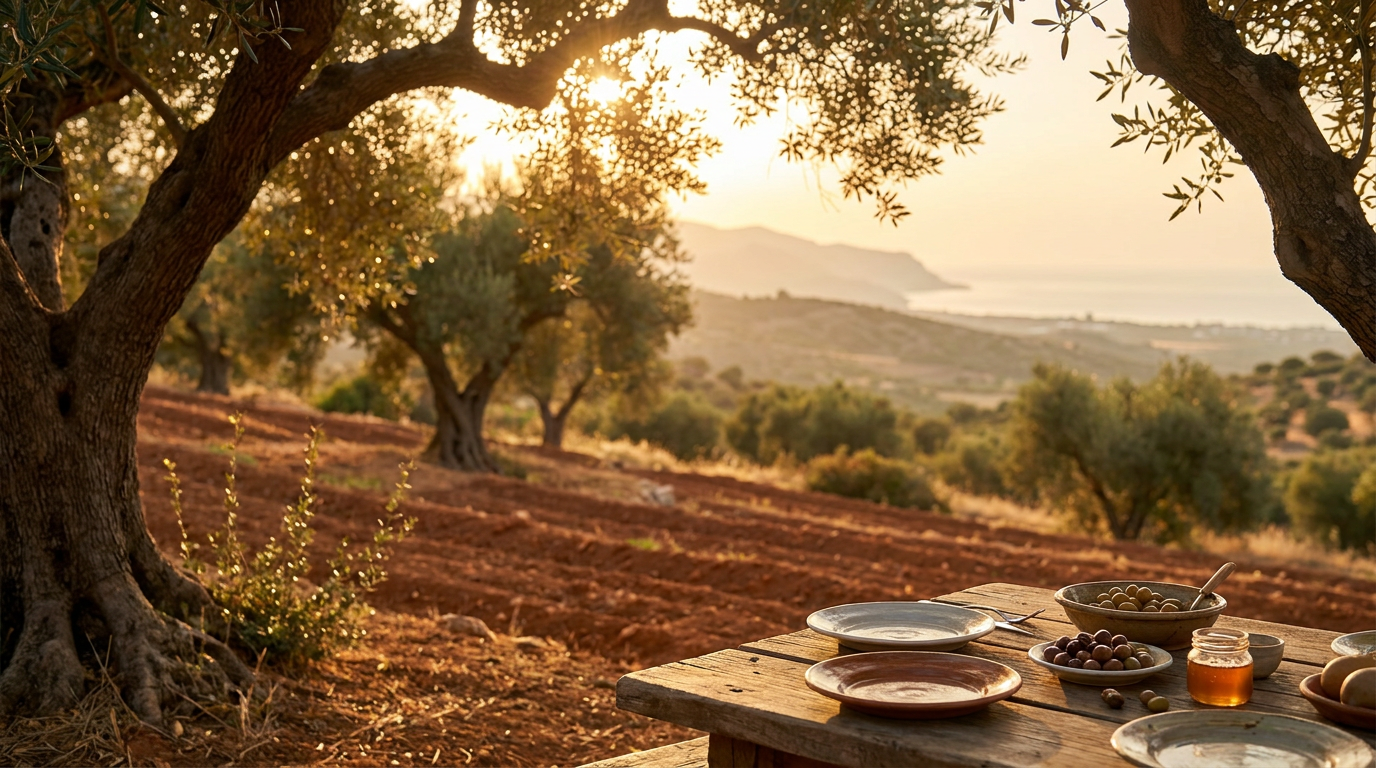
May is the most authentic time for southern Crete because the island is in full bloom after its winter slumber, but the tourist crowds have yet to arrive. In villages like Sivas, you'll experience a quiet and culinary intensity that has long since vanished by high summer, revealing the true, unadulterated taste of the Messara Plain.
TL;DR:
- Fewer people, more Crete: You experience Sivas and Matala before the big summer rush, sharing the tavernas and beaches with the locals.
- Nature's explosion: The olive trees are blooming, wild herbs are fragrant on every corner, and the landscape is lush and green instead of summer-dry.
- Perfect weather: With an average of 24°C, it's warm enough for the sea but still pleasantly cool for hikes through the olive groves.
- Honest flavors: Cretan cuisine is at its best with seasonal ingredients like wild artichokes, which are only available in spring.
At a glance:
- Region: Villages of Sivas & Matala, Messara Plain, Heraklion Prefecture, Southern Crete.
- Best time to visit: May and June for authenticity; October and November for the olive harvest in Crete.
- Climate in May: Avg. 24°C daytime temperature, avg. 19°C water temperature, 8+ hours of sunshine per day.
- Nature's highlight: The blossoming of the Koroneiki olive trees, the foundation of our award-winning olive oil.
- Culinary season: Wild artichokes, fava (split peas), fresh goat and sheep cheeses (Mizithra), snails (Chochlioi).
- Olivora connection: Our olive groves are located in the heart of the Messara Plain, just a few kilometers from Sivas.
Sivas in May: The Heart of Authentic Crete Beats Here
Forget everything you've heard about touristy coastal towns in Crete. Sivas is different. This village, just a few minutes' drive from Matala, is not a holiday resort but a living organism of Cretan daily life. In May, when the air is filled with the scent of orange blossoms and blooming thyme, you can feel the true heartbeat of the south. The village square, the “plateia,” is the center of all activity. Here, old men sit in the traditional kafenions with their Ellinikós Kafé, discussing politics and the upcoming olive harvest, while swallows nest above their heads. It's a place that doesn't put on a show for tourists. It lives for itself, and you're invited to be a part of it for a while.
It can get busier here in high summer, but May is the time for quiet observation. You hear the clicking of kombolói (worry beads), the laughter from the tavernas, and the gentle hum of bees in the bougainvillea hedges. The contrast with the north coast couldn't be greater. While the sun loungers are already lined up there, life in Sivas goes on at its usual, slow pace. It was precisely this authenticity that moved us at Olivora to deepen our roots here in the Messara Plain. Our partners, like the Drakakis family, have lived this culture of mindfulness and respect for nature for generations. When you stroll through the alleys of Sivas, you understand why good olive oil is more than just a product—it's the liquid expression of this way of life.
Matala Beyond the Hippie Caves: A Bay in May's Stillness
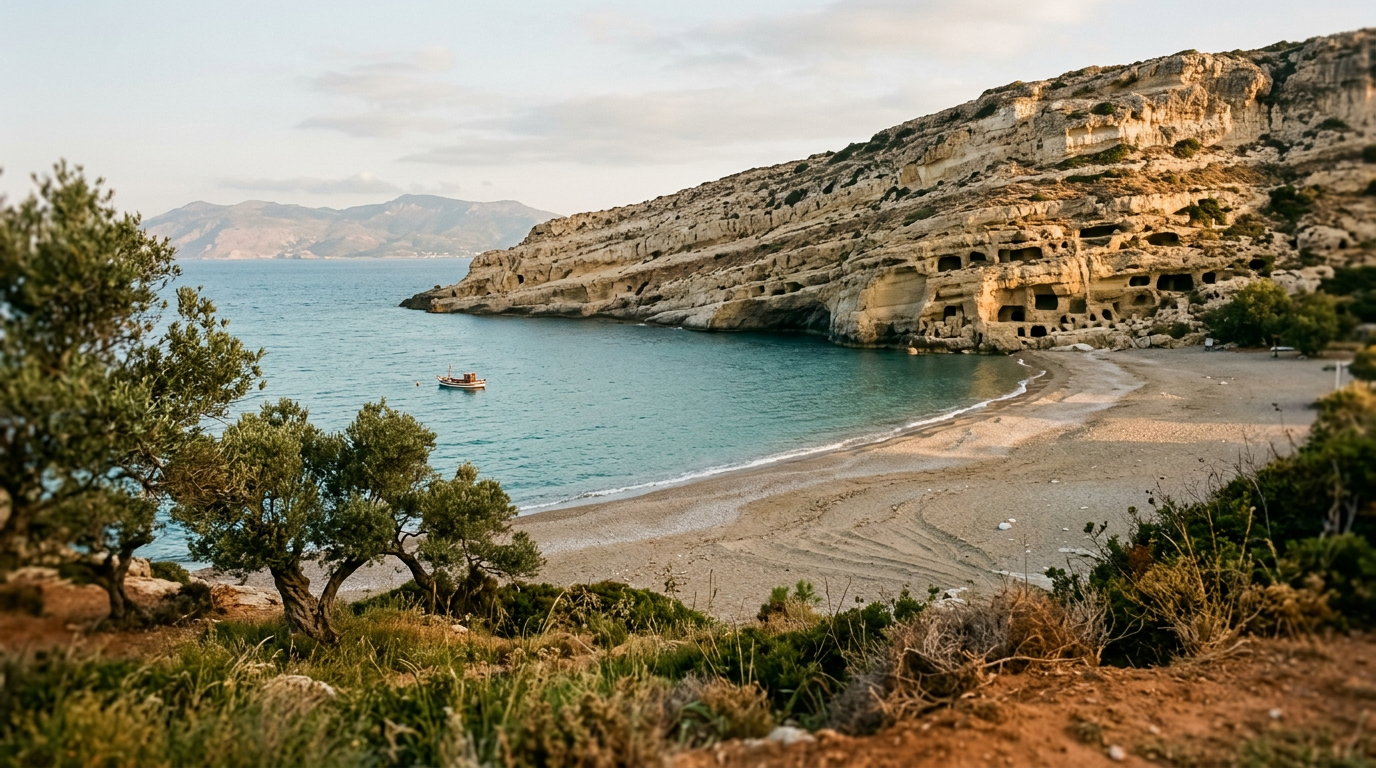
Matala. The name alone evokes images of flower children, Joni Mitchell, and living caves carved into the sandstone. That history is an undeniable part of the place's magic. But in May, you experience a different, deeper side of Matala. The famous bay, which is barely visible for all the people and umbrellas in July and August, now lies still and vast before you. The water of the Libyan Sea is crystal clear and has a refreshing coolness that awakens the body after the first sunbath. You can swim or climb over to the caves without waiting in line and imagine what life was like here in the 60s, or even in Roman antiquity when they served as tombs.
The tavernas on the beach have just put out their tables. The owners are relaxed and happy to see every guest. It's a time for real conversations, not for quick service. You can sit for hours with a glass of wine and a plate of fried calamari, just looking at the sea. The sunset in Matala is legendary, as the sun sinks directly between the two rocky headlands. In May, this spectacle is almost all yours. Yes, anyone looking for a party-central atmosphere will be disappointed. But those who seek the melody of the waves and the taste of salt on their lips will find their temporary paradise here. It is this unadulterated beauty that inspires us and that we want to preserve with every drop of our oil.
The Messara Plain: Crete's Blooming Pantry
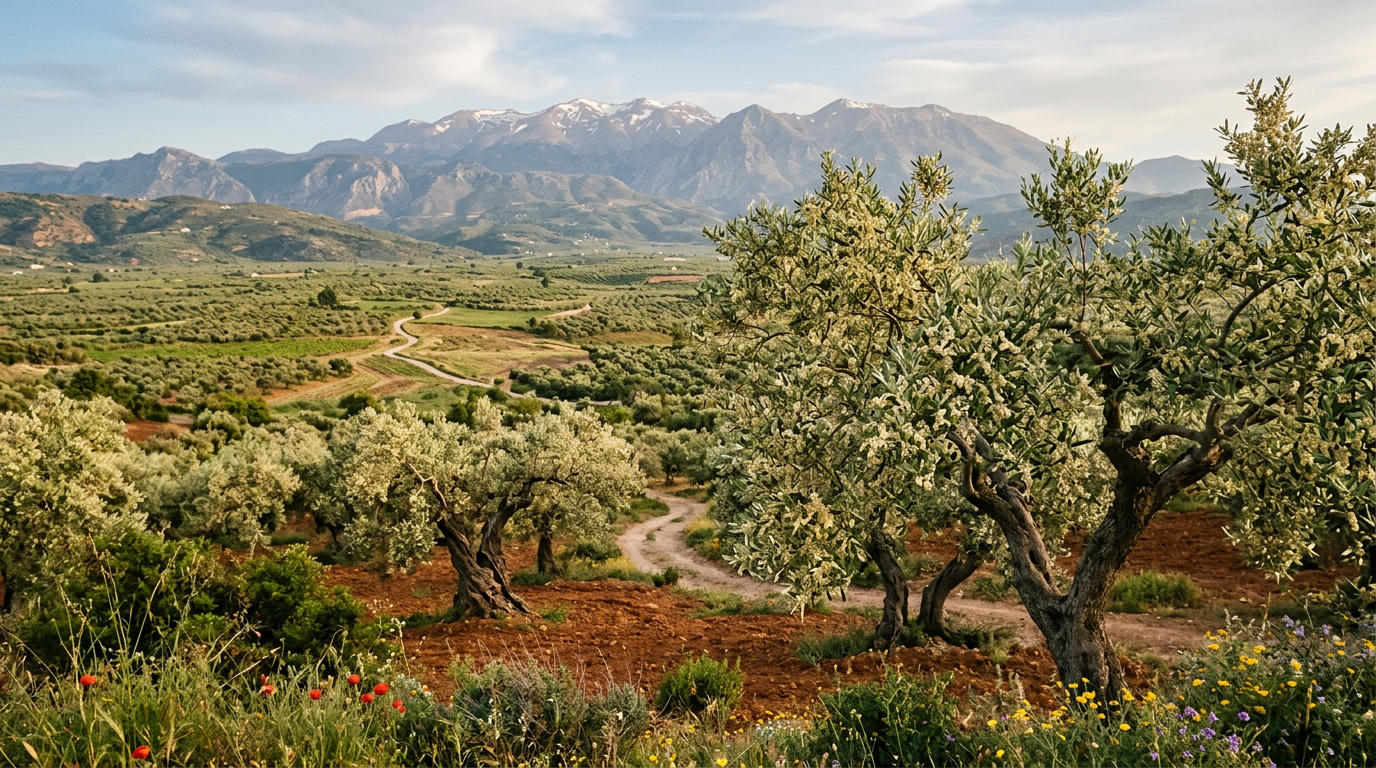
The true magic of the south unfolds in May in the hinterland, in the vastness of the Messara Plain. This fertile plateau is the largest in Crete and the heart of the island's agricultural wealth. In spring, it transforms into a carpet of green, streaked with the silvery shimmer of millions upon millions of olive leaves. It is a landscape that appeals to all the senses and forms the basis for the exceptional quality of our products.
The Olive Blossom – A Promise for Autumn
In late April and May, the small miracle that determines the coming winter's harvest occurs: the olive blossom. The Koroneiki trees adorn themselves with countless tiny, creamy-white flowers that exude a delicate, sweet fragrance. Only a tiny fraction of these blossoms will eventually become an olive; the rest dance like snow in the wind. For the farmers, this is a time of hope and tension. A hot, dry wind (the Livas) or heavy rain can destroy the delicate blossoms and ruin the harvest. When you walk through a grove at this time, you feel the fragile beauty of this moment. Any tree now in full bloom could soon bear the fruit for your personal olive oil if you decide to adopt your own olive tree.
Wild Herbs and Vegetables – Flavors You'll Only Find Now
May is the season of the gatherers. Cretan women (and increasingly men) head out armed with knives and bags to harvest nature's gifts. Wild oregano (rigani), thyme (thymari), sage (faskomilo), and the famous mountain tea, malotira, grow on the slopes. In the fields and along the roadsides, they find wild artichokes (agries anginares), whose tender hearts are a delicacy. They dig for the bulbs of Leopoldia comosa, a type of wild hyacinth, which is served pickled as 'volvi'. You won't find these ingredients in the supermarket. They are the taste of spring in Crete—intense, slightly bitter, incredibly healthy, and the foundation of a cuisine that could not be more seasonal.
Phaistos & Gortyna Without the Crowds
The Messara Plain is also a historical heavyweight. The Minoan palace of Phaistos and the Roman capital of Gortyna are just a stone's throw from Sivas. In May, you can explore these impressive archaeological sites in peace. You don't have to push through crowds and can soak up the energy of these ancient places in the pleasant spring sun. The idea that olive oil was stored in huge clay jars in Phaistos 4,000 years ago connects us directly to the long history of the olive tree and fills us with humility.
Culinary Revelations in May: What's on the Table Now
Cretan cuisine is a cuisine of the seasons. And May is perhaps the most exciting time for food lovers. The heavy, warming fare of winter gives way to light, fresh, and herb-intensive dishes. What comes to the table in the tavernas of Sivas now reflects the blooming landscape. A classic of the season is 'chochlioi'—snails, gathered after the first spring rain and usually prepared in a pan with rosemary and a splash of vinegar. It may take courage to try them, but the taste is unforgettably earthy and savory.
Another highlight is dishes with wild artichoke hearts, often combined with broad beans (koukia) in a stew called 'angináres me koukiá'. The dish is refined with plenty of fresh dill and generously drizzled with olive oil. The light bitter notes of the artichoke harmonize perfectly with the sweetness of the beans and the peppery kick of a good, young oil. Speaking of oil: now is the time to enjoy the last of the winter harvest. A simple salad of tomatoes, cucumbers, and fresh Mizithra cheese becomes a revelation with a generous splash from our Cretan olive oil shop. The flavors are so intense that you barely need more than a pinch of sea salt.
💡 Tip: Ask for "chorta" in the taverna. This is the general term for various edible wild greens, which are briefly blanched and served with only olive oil and lemon. It's the healthiest and most Cretan side dish you can imagine—and perfect proof of why bitterness in olive oil is a sign of quality.
Father Yannis of the Drakakis family, with whom we have harvested our olives for years, once showed us his favorite way to eat wild artichokes in May. He breaks off the outer leaves, cuts off the tip, removes the "choke" inside, and eats the raw heart, drizzled only with a little lemon and dipped in fresh olive oil. "In May," he said with a wink, "the food needs no mask. It is naked and honest." We've never forgotten that.
Your Perfect Day in and around Sivas in May
Imagine a day not dictated by a tight schedule, but by the rhythm of the sun and your own appetite. It could look like this:
Morning (8:00 AM): You wake up to the distant crowing of a rooster. The air is fresh and clear. After a simple breakfast of Greek yogurt, thyme honey, and nuts, you take a walk through the olive groves around Sivas. The earth is still soft from the morning dew, and the scent of olive blossoms accompanies you. You might see a farmer herding his sheep. It's a meditative start to the day. As a member of the Harvest Club, you could even stroll through the rows of your own piece of the grove and greet the trees that will give you their liquid gold in the autumn.
Midday (1:00 PM): You return to the plateia of Sivas. At the "Vafis" or "Sigelakis" taverna, you find a spot under the large mulberry or eucalyptus tree. You don't order from the menu, but ask what 'Mama' has cooked today. There will probably be lamb with stifado onions, perhaps the aforementioned artichokes with beans. With it, a glass of chilled local white wine. Time passes slowly.
Afternoon (4:00 PM): Time for the sea. You drive the short distance to Matala or the neighboring, even quieter Kommos Beach. The sand is warm, but not scorching hot. You spread out your towel, read a few pages in a book, and go for a swim. You'll find you're almost the only person in the water. A feeling of pure freedom.
Evening (7:30 PM): The sun begins to set. You drive to "Red Beach" (Kokkini Ammos) or stay in Matala to watch the sunset from one of the cliff-top tavernas. The light colors the rocks gold and red. Afterwards, you enjoy a light dinner—perhaps grilled fish or a dakos salad with a final glass of Cretan wine. You end the day not exhausted, but deeply relaxed and nourished.
💡 Tip: Rent the smallest car available, not a flashy SUV. The alleys in the old villages are narrow, and your driving style should be as relaxed as the locals'. A horn here is used mainly to greet friends, not as a sign of impatience.
Why May is Superior to High Summer
We love Crete at any time of year, but we are convinced: for an authentic, profound experience, May is by far the best choice. High summer, as sun-drenched as it may be, comes with a few compromises. May, on the other hand, offers the perfect balance.
Crowds & Prices: In July and August, the beaches are full, the tavernas are overflowing, and the prices for accommodation and rental cars reach their peak. In May, you share the beauty of the island with a few other travelers and many locals. Prices are moderate, and you can get a seat everywhere without a reservation.
Heat & Activity: Temperatures of over 35°C in summer make any activity out of the water a strain. A hike through the olive groves? Unthinkable. Climbing the ruins of Phaistos? A sweaty affair. The pleasant 24°C in May is ideal for everything: hiking, lying on the beach, exploring historical sites, strolling through the alleys of a village.
Nature & Landscape: Summer in Crete is dry. The landscape has a stark, golden-brown beauty. But May is a celebration of life. Everything is green, lush, and blooming. The air is full of fragrances. You experience the island in its full vitality, which is particularly impressive when you consider becoming an olive tree sponsor and witnessing your tree's entire annual cycle.
Authenticity & Encounters: In high summer, the tourism machine runs at full throttle. Everything is geared towards efficiency. In May, the atmosphere is personal and relaxed. People have time and are in the mood for a chat. You learn more about the life, culture, and joys of the Cretans. It's the time for genuine encounters, not just transactions. So, for anyone seeking the soul of Crete, not just its sunny surface, May is the time to come.
Frequently Asked Questions
Is May a good time to travel to Crete? Yes, May is an excellent time to travel, especially for the south of Crete. You'll experience the island in full bloom, with pleasant temperatures and without the crowds of high summer. It is the ideal time for nature lovers, hikers, and anyone who wants to get to know the authentic Cretan way of life.
Can you swim in the sea at Matala in May? Absolutely. The Libyan Sea already has a water temperature of around 19 to 20 degrees Celsius in May. It's refreshing and invigorating, especially after sunbathing. The beaches are clean and wonderfully empty, making your swimming experience very relaxed.
What clothes should I pack for Crete in May? It's best to pack layers. During the day, T-shirts, light trousers or dresses, and shorts are ideal. For the evenings, however, especially near the coast or in the mountains, you should definitely bring a sweater or a light jacket, as it can still get cool.
What is special about the village of Sivas? Sivas is a traditional, heritage-protected village that has preserved its authentic character. Unlike pure tourist resorts, it is a living village with a central plateia, cozy kafenions, and excellent tavernas. It is the perfect base for exploring the Messara Plain, Matala, and the surrounding beaches.
Do the olive trees bloom in May? Yes, the delicate phase of the olive blossom takes place from late April into May. The trees are covered with thousands of small, white flowers. It is a beautiful sight and a crucial moment that determines the potential for the olive harvest in autumn.
Is an olive tree adoption particularly worthwhile in May? Yes, very much so. If you start an adoption for a Cretan olive tree in May, you see your tree in its most hopeful phase—the blossom. This creates a special connection and heightens the anticipation for your first own harvest of oil in the autumn.
Are there any special festivals in Sivas or Matala in May? In May, there are smaller, local festivals, often in honor of a village saint (panigiri). There are no large, organized tourist events. That's precisely the appeal: you have the chance to take part in an authentic, local celebration if you're in the right place at the right time.